
 Hopper Cleaning and Specialized Rope Access Paint Stripping for Food Manufacturer
 Hopper Cleaning and Specialized Rope Access Paint Stripping for Food Manufacturer
Techniques Used: Media Blasting
Service: Paint Removal
An issue at a food manufacturing facility required immediate intervention to protect their product. The facility was experiencing issues with their food storage hoppers. The containers had been painted in the past and, over time, had broken down, causing paint flakes to fall into the food supply.
This degradation led to contaminated product batches and rejected shipments from customers, putting stress on their distribution network. They needed a team to strip the coating from all the hoppers as quickly as possible while the plant remained fully operational. This required a team with deep technical strategy who could guarantee zero dust migration while performing the remediation.
The general contractor reached out to Wickens to manage the complex hopper cleaning and our crew was quick on the scene.
Results at a Glance
- Successfully stripped and remediated all paint contamination
- Expanded the project scope from eight hoppers to 12 total units
- Finalized the entire remediation within 36 working days
- Completed the high-risk project entirely on budget with zero operational delays
- Maintained continuous production for the facility
- Achieved full client satisfaction from both the general contractor and facility operator
The Challenges
This project came with challenges that required a custom approach to the industrial cleaning process.
Confined Space Access
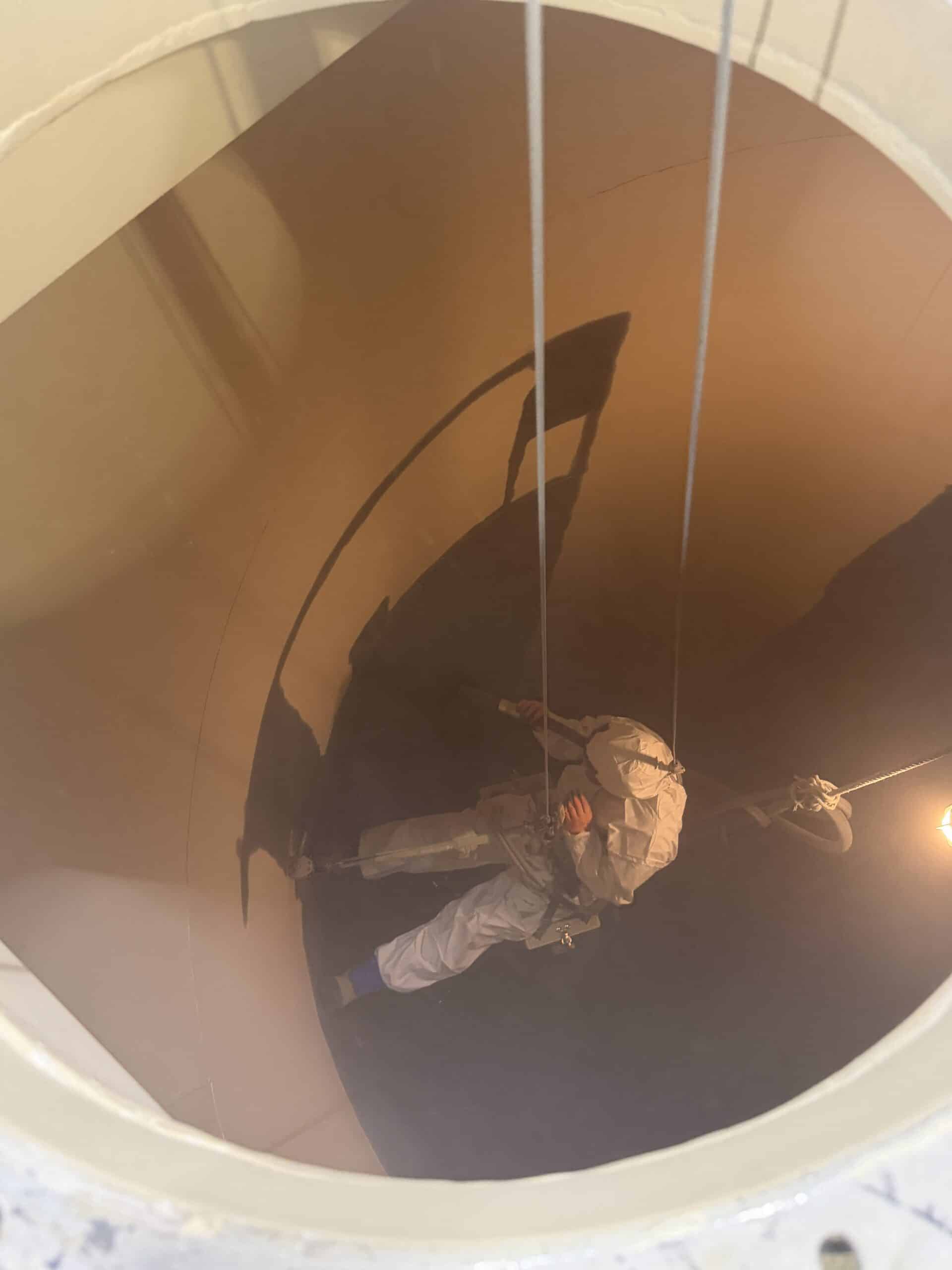
First, the 40-foot height and narrow configuration of the hoppers made access challenging for technicians and blasting equipment. Scaffolding wasn’t an option, as it was cost-prohibitive and would be too challenging to maneuver in the restricted area. Our team had to find a solution to get into each hopper and clean it without extending the project timeline, turning the job into a highly complex confined space cleaning operation.
Strict Food Safety Material Constraints
Working in an active food manufacturing facility requires the exclusive use of food-grade compliant blasting media. The material we used had to strip the paint cleanly without profiling, etching, or damaging the tank surfaces, so standard abrasive techniques couldn’t be used for fear of degradation and foreign material embedding itself in food contact zones.
Cross Contamination Risks
Finally, environmental cross-contamination had to be completely prevented to protect the active food production areas surrounding the hoppers. The facility couldn’t tolerate airborne paint dust or stray blasting particles escaping into the ambient atmosphere during operations, and a complete plant shutdown wasn’t possible.
The Solutions
Despite the challenges the project offered, our team jumped into gear to find practical solutions and get the project done for our client.
Innovative Rope Access
To address the restrictive layout and complete the necessary maneuvers inside the hoppers, the team engineered a technical confined space cleaning method to bypass traditional scaffolding completely. Technicians performed the delicate paint stripping directly from a flexible bosun chair setup suspended inside the structures.
To counteract the natural air pressure pushback generated during blasting operations, the technicians used an innovative magnet system to anchor against the stainless steel tank walls while blasting.
Our team executed dedicated trial runs during the first few days to validate safety protocols. Operations were managed by a certified three-person crew consisting of two operators and one supervisor who held valid certifications for confined space entry, working at heights, and Industrial Aerial Work Platform operation.
Blasting with Specialty Media
Material selection was critical to this project, so our team spent several days researching and field testing various materials, including soda and lime. Following successful testing, the team chose a food-safe, specialized media for this project.
The media we chose provided the necessary level of abrasion for paint removal while leaving the stainless steel surface completely unmarred and food-safe.
Negative Pressure Containment
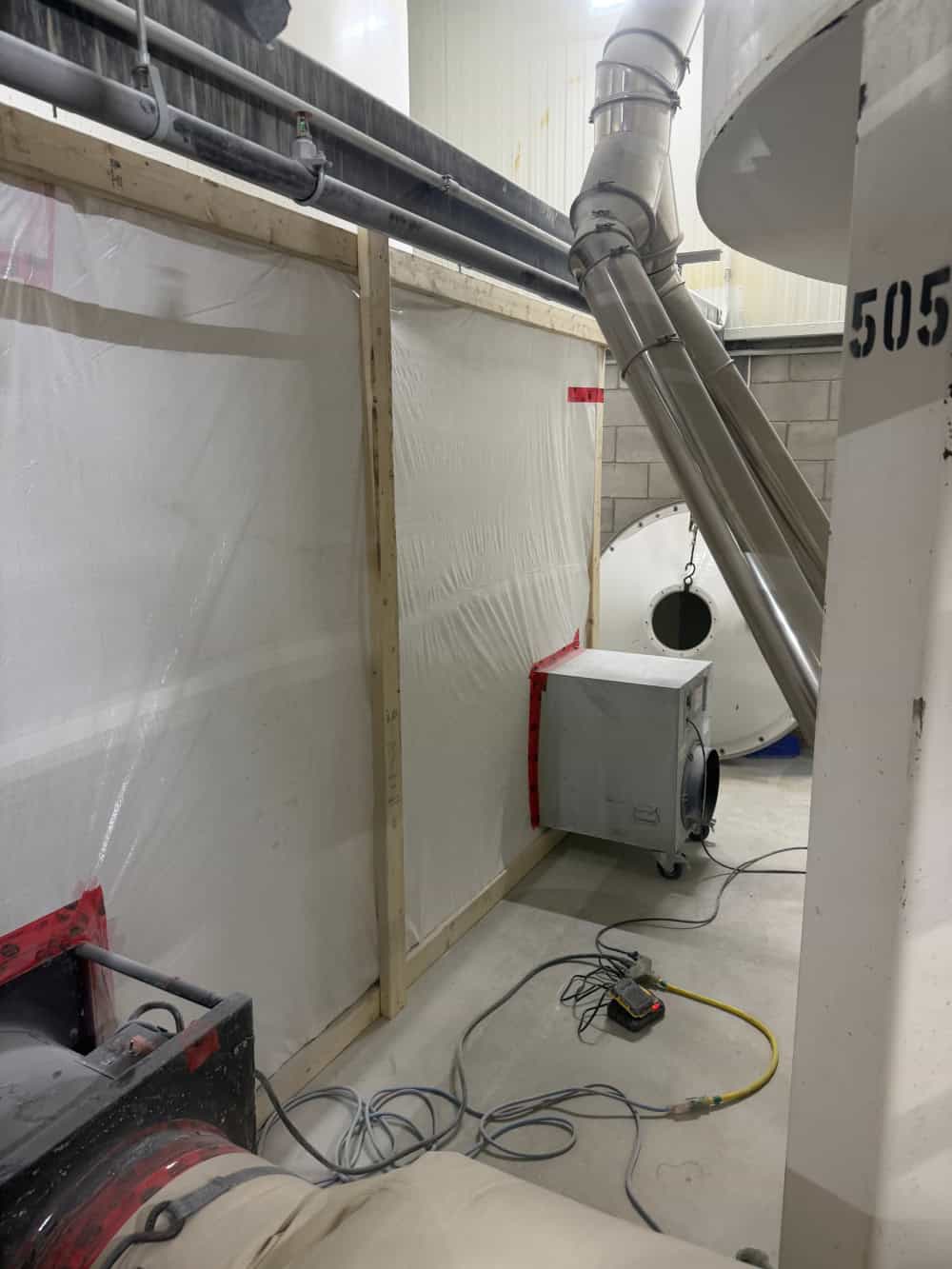
To manage environmental risks and ensure no contamination, individual containment zones were constructed at the bottom of each hopper before blasting began. These isolated containment systems were put under constant negative pressure and connected to industrial dust collection machinery to capture every particle of blasted paint and spent media.
Strategic Operating Schedule
Closing operations entirely was impossible for the client, which meant we had to create an operations schedule to suit their needs. Our team ran an aggressive back-to-back schedule operating in 12-hour shifts, processing two tanks at a time. In the meantime, facility staff would empty the next hoppers for cleaning and refill the cleaned hoppers.
This also meant that all operations were completed while the facility was operating live. Our scheduling allowed the plant to safely bypass the active work zones and maintain continuous production without shutting down their operations.
The Results
Thanks to our strategic execution, our team delivered exceptional results, completely stripping and remediating the paint contamination across eight hoppers. Once the client reviewed the quality of the first few tanks, they even expanded the scope from the initial eight hoppers to 12 total units.
Remediation was completed over six weeks, adhering strictly to the planned turnaround schedule. The project also concluded completely on budget with zero operational delays, zero dust migration, and zero additional issues.
Both the general contractor and facility operator expressed complete satisfaction with the job site cleanliness, crew work ethic, and technical project execution.
If you have an industrial facility in need of cleaning or remediation, contact Wickens today – we’ll give you a full quote and build a custom strategy based on your facility’s requirements.